
The Circularity Loop connects global policy, local implementation, and narrative change so that circular economy becomes the new norm rather than a niche.
This creates a time-bound window to realign rules, finance, innovation and business models around circularity and justice – or lock in another decade of fragmentation.
The Circularity Loop connects global policy, local implementation, and narrative change so that circular economy becomes the new norm rather than a niche.
This creates a time-bound window to realign rules, finance, innovation and business models around circularity and justice – or lock in another decade of fragmentation.
Why circularity
We envision economies where:
→ Value is measured not only by production, but by restoration and social impact.
→ Materials circulate within planetary boundaries.
→ Circular design, responsible finance, and inclusive governance reinforce each other.
The world is still locked into a linear model — extract, produce, discard. Plastics and textiles are among the fastest-growing sources of pollution, greenhouse gas emissions, and social inequity. The same systems that drive the plastic crisis also fuel methane emissions from mismanaged waste and accelerate the degradation of ecosystems and communities.

CIRCULARITY
How we create change
HOST HIGH-IMPACT DIALOGUES
And labs where policy, finance and practice sit at the same table.
BUILD NATIONALAND REGIONAL HUBS
To map barriers, align ambition and design roadmaps.
TRANSLATE TECHNICAL DISCUSSIONS
Into clear policy options and investment pipelines.
MAINTAIN FEEDBACK LOOPS
So lessons from the ground reshape global decisions.
CIRCULARITY
Our systems-change approach
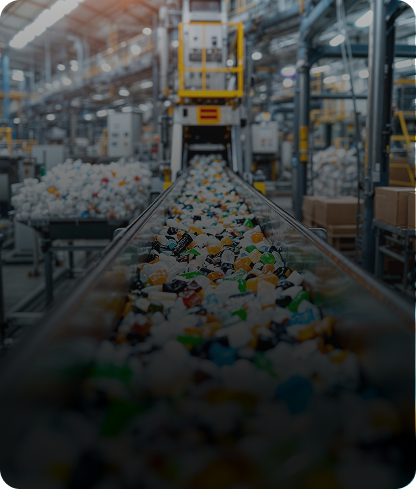
The Circular Loop acts as a system catalyst, connecting actors and ideas across silos to shift underlying conditions in plastics, waste, methane, and textiles. We work at three interconnected levels.
Mindsets & narratives – how problems and solutions are framed.
→ Shift from “waste management” to material and value redesign.
→ Use storytelling, research and events to make circularity the new normal.
Relationships – who
collaborates and who decides.
→ Bring together governments,
industry, waste pickers,
workers, investors, and experts.
→ Rebalance power so producing
regions and vulnerable groups
shape the transition.
Structures – rules, incentives,
infrastructure.
→ Support Plastics Treaty
implementation, EPR frameworks,
and policy reforms.
→ Co-lead UNEP’s Textile Action
Agenda for a just, circular textile
value chain.

Plastics, Waste & Methane
FACT SHEETS
WEBINAR
The Circular Loop advances a new paradigm for waste management by explicitly connecting plastic pollution and methane reduction agendas. We work with the Global Methane Hub, local partners, and waste picker organizations to:
Enforce and scale waste separation at source and organic waste valorization. -Improve labour conditions, social protection, and recognition for waste pickers.
Clean and safe composting material for organic waste valorization. -Strengthen municipal capacity to design and finance sustainable waste systems.
Inform Global Plastics Treaty negotiations with evidence and implementation pathways.
Develop guidelines and case studies, especially from the Global South, showcasing environmental, social, and economic benefits for local governments as key climate actors.

Textiles & Materials
FACT SHEETS
WEBINAR
Through the Ambition Loop partnership pipeline, the Circular Loop co-leads the Textile Action Agenda, a global effort to align policy, finance, and practice so that circular textiles become the default.
We work with governments, brands, academia, and technical experts to: Create awareness about hazardous chemicals. Help align standards, regulations and incentives across countries and regions.
Connect policy with brands, investors and innovators to move beyond pilots. Ensure workers and communities are part of a just transition, not an afterthought.
15-17 JUNE
SANTIAGO CHILE
GLOBAL TEXTILE MINISTERIAL AND INDUSTRY SUMMIT
Hosted by Chile’s Ministry of the Environment, organised by Ambition Loop and in collaboration with UNEP and ZDHC.
Accelerating Policy, Finance & Innovation for a Just, Circular Textile Economy.
-
The Global Textile Ministerial and Industry Summit – Santiago (June, 2026) is a pivotal moment in that transition. Hosted by Chile and co-organized by Ambition Loop, this first-of-its-kind, Global South–led summit brings together ministers, CEOs, investors, and standard-setters to accelerate coordination on the core enablers of circularity: Extended Producer Responsibility (EPR), chemicals and production standards, sustainable consumption, and trade systems.
Why the Global South? Because it is where policy innovation, manufacturing, second-hand markets, and environmental impacts converge. Chile—one of the world’s largest importers of used textiles and a regional circular economy frontrunner—offers a powerful platform to connect South–South and South–North leadership, ensuring global rules reflect real supply-chain realities.More than a convening, the Summit is designed to deliver outcomes: aligned policy pathways, investable pilots, clearer standards, and shared signals to markets. It is where public ambition meets private implementation—and where the next phase of textile circularity takes shape.
This is not about incremental change. It is about building the coordinated systems the textile sector needs to transition—credibly, fairly, and at scale.
TEXTILES & MATERIALS
Why now & why Chile
MOMENTUM
Mindsets & narratives – how problems and solutions are framed.
→ Shift from “waste management” to material and value redesign.
→ Use storytelling, research and events to make circularity the new normal.
→ Enables early actions that can feed into Q3–Q4 platforms:
London & New York Climate Weeks, COP31, and the Global Framework on Chemicals First International Conference.
STRATEGIC TIMING
WHY CHILE
→ Regional frontrunner with a Circular Economy Strategy for Textiles, an advancing EPR roadmap, and a strong innovation and academic ecosystem.
→ Chile is among the world’s top 10 importers of used textiles, making it a key distribution hub for Latin America’s second-hand clothing market.

TEXTILES & MATERIALS
Executive snapshot
A high-ambition global textile summit designed to accelerate coordination between governments, industry and civil society to build a sustainable and circular textile value chain.

First Global South–led state and non-state actors summit of its kind, designed for South–South and South–North knowledge exchange.

Connects policy, finance, and innovation.

Anchored and aligned with major global platforms and multilateral agendas.

Interested in partnering with Ambition Loop on Circularity?
Get Involved
